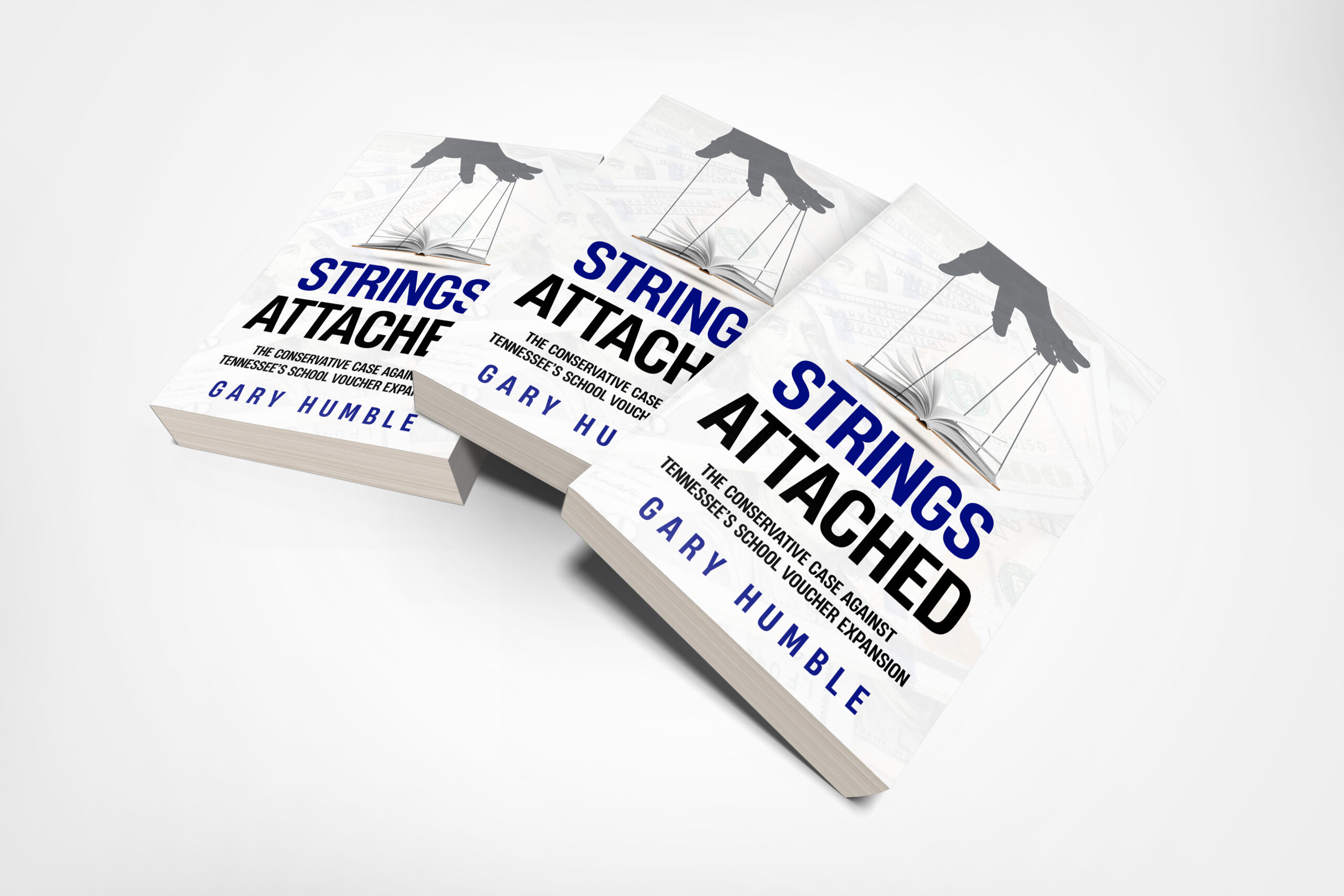
Strings Attached
The Conservative Case Against Tennessee’s School Voucher Expansion
Written for Tennessee conservatives who value educational freedom and fiscal responsibility, this brief but powerful examination exposes the true nature of school vouchers and offers real solutions for improving education without expanding government control.
...or scroll down to DOWNLOAD the PDF for absolutely FREE.
Click the button to contact your Tennessee state legislators. Ask them to oppose school vouchers!
Governor Bill Lee's Voucher Proposal is Not Conservative
Costs
Year (1) estimates are $400+ MILLION, including paying for the same student TWICE!
New Entitlement
Vouchers are NOT a tax refund, but a new state and local public benefit, the same as welfare programs.
Regulations
Introduces new standardized testing requirements on private schools.
Expands Failure
Recent TCAP data already shows that ESA students are not meeting state standards.
Costs
Year (1) estimates are $400+ MILLION, including paying for the same student TWICE!
New Entitlement
Vouchers are NOT a tax refund, but a new state and local public benefit, the same as welfare programs.
Regulations
Introduces new standardized testing requirements on private schools.
Expands Failure
Recent TCAP data already shows that ESA students are not meeting state standards.



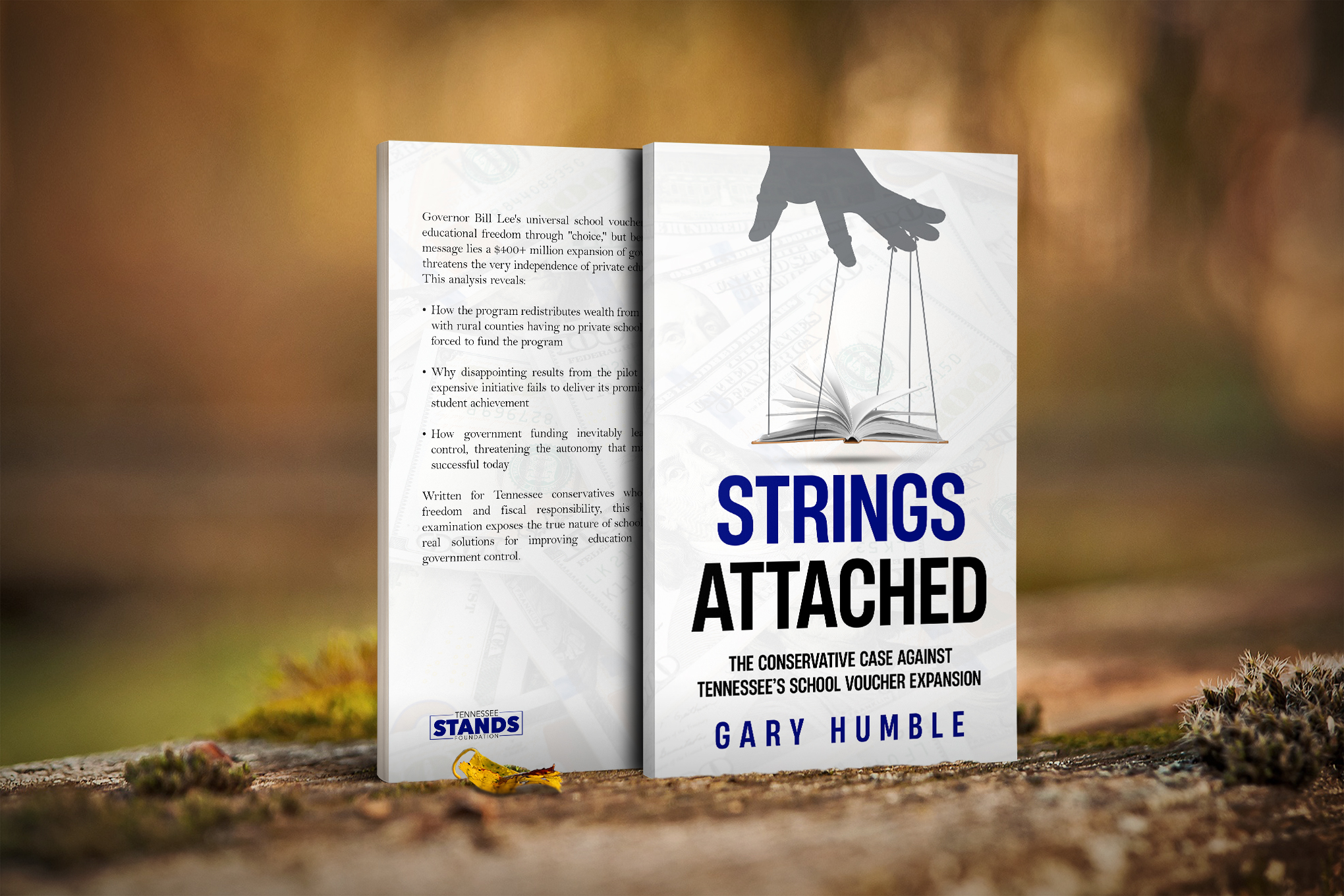
Your Conservative Resource on the Dangers of School Vouchers in Tennessee
Our goal is to get this message out to as many people as possible. So, we have made this resource accessible and very affordable. You can order the paperback for only $3.99 from Amazon and the Kindle (eBook) version is available for only $0.99.
You can also download a PDF of the entire book absolutely free. Just click the DOWNLOAD button below.

Want to know exactly what's in the bill?
Watch this video from Executive Director of Tennessee Stands, Gary Humble, to see a complete breakdown of exactly what is in the Governor's Education Freedom Act of 2025.
This bill was filed in November of 2024 (HB1 / SB1) and current suspicions are that a special session will be called to take a vote on the bill in January. This will happen fast, so now is the time to get involved, get educated on the issue, and contact your state legislators, asking them to vote NO.
Tennessee does not need a new entitlement program.
The evidence is clear. The pilot program’s disappointing academic results show that ESA students perform no better, and sometimes worse, than their public school peers. Yet proponents push to expand this failing model statewide at a staggering cost, exceeding $400 million in its first year alone. This represents not just a financial burden on Tennessee taxpayers but a fundamental threat to a parent’s right to educate their child free from government constraints.
The program’s structural flaws are impossible to ignore. More than half of Tennessee’s counties have no qualifying private schools, meaning rural taxpayers would be forced to fund an educational program they cannot access. The “do no harm” funding provision creates confusion about duplicative payments, while the $2,000 teacher bonuses appear designed to buy support rather than improve education. Most troublingly, the program opens the door to expanding government control over private education through administrative rulemaking that could occur largely outside public view.
We must remember that Tennessee parents already have complete educational freedom and choice. They can choose public schools, private schools, homeschooling, or hybrid models. What proponents actually seek isn’t educational choice but government subsidy of private choices. This distinction matters deeply because government funding inevitably leads to government control.
Tennessee’s educational future depends on preserving genuine educational freedom—not replacing it with government-funded and government-controlled alternatives. The path to better education lies not in expanded government involvement but in protecting and strengthening the independence that allows genuine educational excellence to flourish.
Listen to what Robert Bortins, CEO of Classical Conversations, has to say about Tennessee's school voucher proposal.
Classical Conversations is a homeschool movement with over 130,000 students in over 60 countries. CEO, Robert Bortins has traveled the country exposing the dangers of proposed school voucher programs and finds that Tennessee’s proposal is the worst of them all. Don’t miss this important conversation.
A real common sense conversation about school vouchers.
In this episode, we are digging in a bit deeper into the school choice discussion. Beyond the billboards telling you that you are getting $7,000 for your child’s education, how does the program really function? What are the fundamental distinctions between public and private schools? Is this truly a tax rebate or is this wealth redistribution? Could private schools face greater government constraints in the future?
Frequently Asked Questions
WHY DO YOU CALL SCHOOL VOUCHERS AN ENTITLEMENT PROGRAM?
An ESA voucher takes tax dollars from all Tennesseans and redistributes them to provide education benefits to select families. By definition, this is an entitlement – government money provided to individuals who meet certain criteria. Once tax dollars enter government coffers, they become public funds, not personal money being “returned.”
WON'T THIS PROGRAM CREATE COMPETITION AND CAUSE PUBLIC SCHOOLS TO IMPROVE?
No. The bill’s “do no harm” clause ensures public schools keep the same funding even when students leave. With no financial consequences for poor performance, there’s no incentive to improve. Additionally, regulations that hamper public schools remain in place. True competition would require deregulating public schools to operate more like private ones.
IT'S MY MONEY AND I WANT IT BACK. SHOULDN'T I GET MY TAX DOLLARS BACK TO USE FOR EDUCATION?
Taxes, once collected, become public funds to be used for public purposes. This program doesn’t “return” your specific tax dollars – it creates a new government benefit program funded by all taxpayers. In 51 of 95 Tennessee counties that have no qualifying private schools, taxpayers would fund a program they cannot access.
COULD THIS VOUCHER PROGRAM CAUSE TAX INCREASES?
Yes. The program’s first-year cost exceeds $400 million, including $140 million for vouchers, $140 million in continued funding to public schools for students they no longer serve, and $2,000 bonuses for all teachers. As participation grows, these costs will increase, likely requiring additional revenue through taxes.
THE GOVERNOR SAYS THAT THE BILL HAS "NO STRINGS ATTACHED." WHY ARE YOU CONCERNED ABOUT MORE REGULATIONS FOR PRIVATE SCHOOLS?
The bill already requires state testing and reporting requirements. More importantly, it authorizes the Department of Education to establish additional “requirements” through administrative rulemaking – a process that occurs after the bill passes and with limited public oversight. History shows government funding inevitably leads to government control.
WHAT IS THE DIFFERENCE BETWEEN AN ESA (VOUCHER) AND A TAX CREDIT?
An ESA voucher is government money given to qualifying families, making it subject to government control and regulation. A tax credit simply allows families to keep more of their own money for education expenses. Tax credits avoid the regulatory risks of vouchers because they never become government funds requiring “accountability.” We support tax credits, but not vouchers.
More Resources from Tennessee Stands
on School Vouchers



Click the button to contact your Tennessee state legislators. Ask them to oppose school vouchers!
TENNESSEE STANDS ⋅ 711 SIGNAL MOUNTAIN RD, #133 ⋅ CHATTANOOGA, TN ⋅ 37405
© 2026 Citizens for Limited Government and Constitutional Integrity, Inc. Tennessee Stands is an IRS-designated 501(c)(4) policy and advocacy organization. Educational efforts on government and constitutional issues are handled by our partner, The Tennessee Stands Foundation, Inc., a Tennessee nonprofit and IRS-designated 501(c)(3) organization. NOTE: Referral to websites not produced by Tennessee Stands is for informational purposes only and does not necessarily constitute an endorsement of the site’s content.